

Why Capital Is Rotating Back Into Alternatives
After several years marked by rising interest rates, constrained exit markets, and cautious capital deployment, private equity investors are entering 2026 with renewed, but disciplined optimism. Across institutional allocators, family offices, and advisors, sentiment has shifted from capital preservation toward selective deployment as conditions across private markets stabilize.
While the environment remains more demanding than the ultra-low-rate era of the past decade, greater visibility into financing, valuations, and exit pathways is driving a more constructive outlook for private equity and alternative investments.
What’s Driving Private Equity Optimism in 2026
- Stabilizing Financing Conditions
One of the most significant challenges for private equity in recent years was the speed and magnitude of interest-rate increases, which pressured deal economics and delayed exits. Entering 2026, financing markets have become more predictable, even if borrowing costs remain structurally higher.
This improved clarity has allowed sponsors to underwrite transactions with greater confidence and reengage in acquisitions, refinancings, and growth initiatives.
- Dry Powder and Deployment Pressure
Private equity firms continue to hold substantial uninvested capital accumulated during slower deployment periods. Combined with aging portfolio companies, this dynamic is creating increased pressure to deploy capital and pursue liquidity solutions.
At the same time, valuation resets across multiple sectors—including technology, consumer, and lower middle-market businesses—are presenting more rational entry points than those seen during the 2020–2021 peak.
- Exit Pathways Are Becoming More Flexible
While IPO markets remain selective, alternative exit strategies are gaining momentum. Private-to-private transactions, minority recapitalizations, structured secondaries, and continuation vehicles are increasingly common tools for sponsors managing liquidity and portfolio duration.
Rather than relying on a single exit channel, private equity firms are navigating a broader and more adaptable set of outcomes, contributing to improved sentiment entering 2026.
The Expanding Role of Alternatives in Institutional Portfolios
As private equity activity normalizes, investors are continuing to broaden their exposure across alternative asset classes to enhance diversification and reduce reliance on public markets. Common allocations include:
- Private equity (buyout, growth, and special situations)
- Private credit, including direct lending and opportunistic strategies
- Real estate and real assets
- Venture capital and late-stage growth equity
For many institutions and advisors, alternatives are no longer tactical allocations—they are core components of long-term portfolio construction.
How the FNEX Alternatives Market Supports 2026 Allocation Strategies
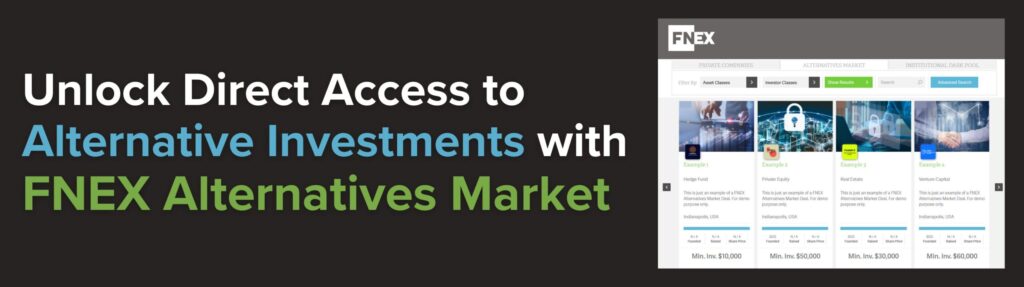
As demand for alternatives grows, access, diligence, and execution quality are increasingly important. The FNEX Alternatives Market is an alternative investment platform that provides advisors and institutions with curated access to private market strategies across:
- Private equity
- Private credit
- Real estate and real assets
- Venture capital and growth strategies
The FNEX Alternatives Market provides scalable access to differentiated alternative investments aligned with long-term investment objectives—without reliance on opaque feeder structures.
Learn More About FNEX Alternatives Market
FNEX Perspective on Alternative Investments
As private equity investors reengage in 2026, the need for direct access to alternative investments continues to expand. The FNEX Alternatives Market is designed to support this next phase of private market evolution—connecting advisors, institutions, and asset managers through a platform built for transparency, scale, and long-term partnership.
In a market defined by opportunity and selectivity, FNEX helps investors put private market capital to work with confidence.
Disclaimer: The FNEX Alternatives Marketplace is intended for use by financial professionals only. Access is restricted to registered investment advisors, broker-dealers, and other qualified institutional investors.