
Private markets entered 2026 with renewed momentum. Capital is flowing back into venture funds, large private companies continue to attract significant financing, and secondary markets are playing an increasingly important role in providing liquidity and access.
But beneath the headline numbers, the market is becoming increasingly concentrated.
Caplight’s 1H 2026 Venture Market Update shows a private market where established managers, mega-rounds, SPVs, and a relatively small group of highly sought-after private companies are capturing an outsized share of activity.
For investors, that is changing how capital moves through the private markets.
Private Technology Started 2026 Strong
Late-stage private technology companies began the year with significant momentum.
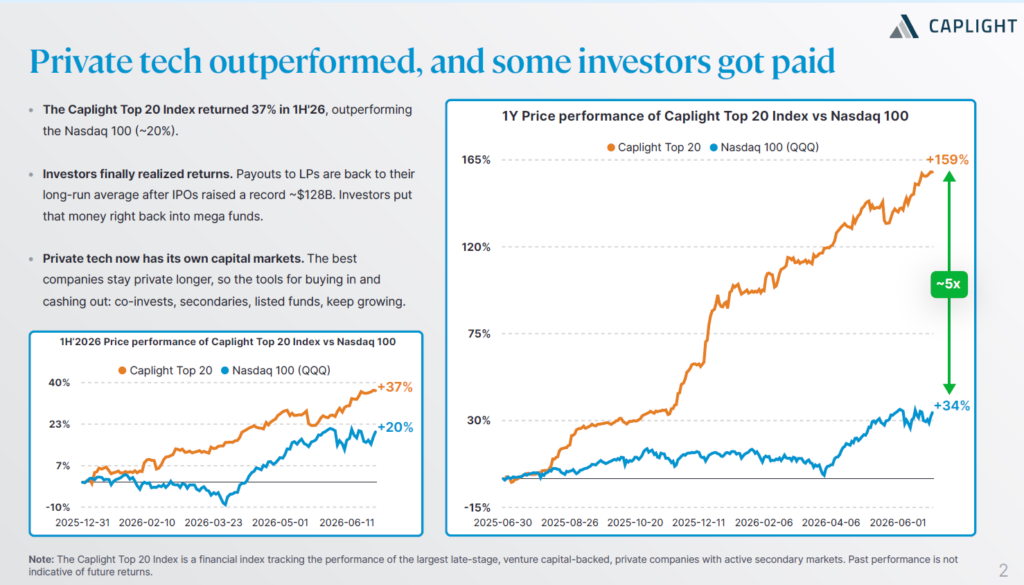
The Caplight Top 20 Index, which tracks large late-stage venture-backed private companies with active secondary markets, returned 37% during the first half of 2026, compared with approximately 20% for the Nasdaq 100. Caplight also notes that past performance is not indicative of future returns.
At the same time, liquidity has begun returning to venture markets. According to Caplight, LP distributions returned to their long-term average for the first time since 2022.
That combination of liquidity and renewed fundraising is creating additional capital that can be deployed back into private markets.
Venture Capital Is Flowing Toward Fewer, Larger Players
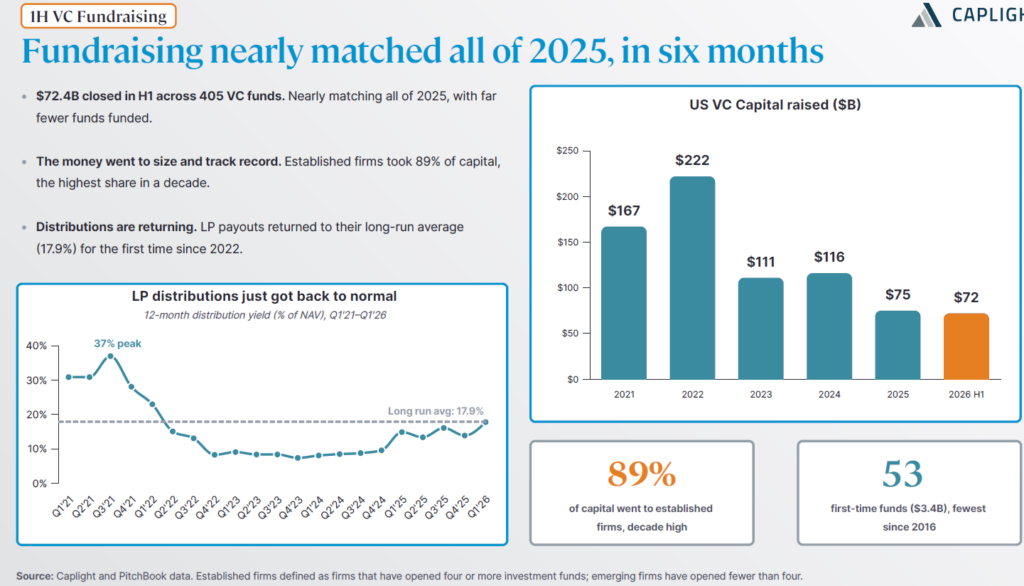
U.S. venture funds raised $72.4 billion across 405 funds during the first half of 2026, nearly matching the $75 billion raised during all of 2025.
But the capital was highly concentrated.
Established firms captured 89% of capital raised, the highest share in a decade. Five firms alone raised approximately $42 billion during the first six months of the year.
The same concentration is visible in venture deployment.
Caplight reports that $274 billion was deployed into venture-growth companies during H1 2026, already more than twice the total for 2025. A small number of exceptionally large rounds accounted for much of that activity, with AI representing 86% of H1 deal value while accounting for 43% of deal count.
The numbers point to a market with substantial capital available, but one where that capital is increasingly concentrated around established managers and large private companies.
Secondary Markets Remain Near Record Levels
The secondary market has become another important component of the private capital ecosystem.
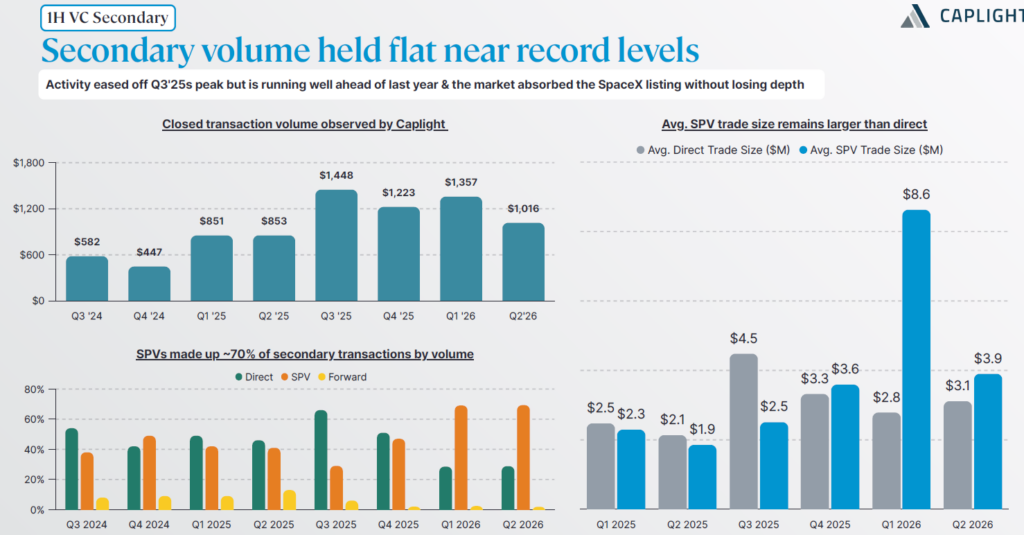
Caplight observed $1.016 billion of closed secondary transaction volume in Q2 2026, following $1.357 billion in Q1. While activity has moderated from the Q3 2025 peak, it remains significantly above levels seen in 2024 and early 2025.
Secondary transactions can allow existing shareholders to seek liquidity without waiting for an IPO or acquisition, while providing investors another avenue for gaining exposure to established private companies.
That role may become increasingly important as companies remain private longer and continue raising substantial amounts of capital outside the public markets.
SPVs Are Becoming a Major Part of the Secondary Market
One of the most significant developments is the growing role of special purpose vehicles, or SPVs.
According to Caplight, SPVs represented approximately 70% of secondary transaction volume in Q2 2026. Caplight’s data also shows that average SPV trade sizes have generally exceeded average direct-share trade sizes.
SPVs can aggregate investors into a single vehicle that holds an interest in a private company, providing an alternative structure to purchasing private-company shares directly.
Their growing share of transaction volume demonstrates how the infrastructure surrounding pre-IPO investing continues to evolve alongside the market itself.
Larger Rounds Are Creating New Investment Structures
The growth of private-company financing is also changing how investors participate in primary rounds.
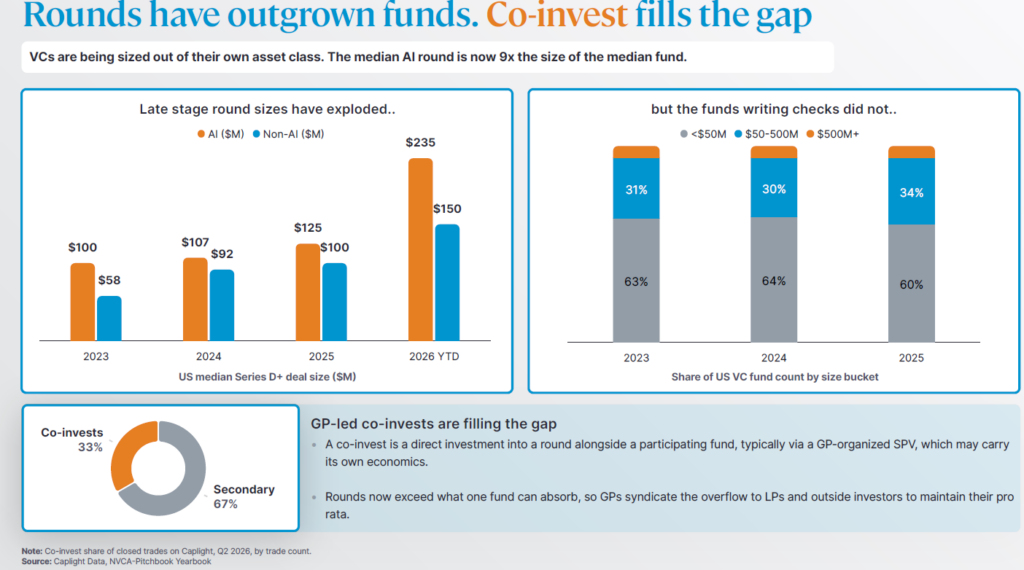
Caplight reports that the median U.S. Series D+ AI financing reached $235 million in 2026 YTD, compared with $125 million in 2025. The report argues that these increasingly large rounds can exceed what individual venture funds are positioned to absorb, creating greater demand for co-investment structures.
Caplight’s observed transactions show 33% co-investments and 67% secondary transactions. It describes co-investments as direct investments alongside participating funds, typically through GP-organized SPVs.
The result is an increasingly interconnected private market where direct shares, secondaries, SPVs, co-investments, and private-market funds can provide different avenues for participation.
The Pre-IPO Market Is Becoming Its Own Capital Market
Perhaps the larger takeaway is that private markets are developing infrastructure that historically existed primarily in public markets.
Companies can raise substantial amounts of capital while remaining private. Existing shareholders can seek liquidity through secondary transactions. SPVs and co-investments can facilitate participation in increasingly large transactions.
And new investment vehicles are creating additional sources of demand. Caplight reports that seven retail-facing funds collectively hold more than $4 billion in pre-IPO equity, with many holding overlapping positions in prominent private companies.
The distinction between a company’s private and public-market phases is therefore becoming increasingly important for investors.
How FNEX Provides Access to the Private Market
As the private market expands, access and transaction infrastructure are becoming increasingly important.
FNEX provides qualified investors multiple ways to participate in the pre-IPO market, including direct private-company shares and SPV opportunities through the FNEX Pre-IPO Market.
FNEX also offers SPV investment opportunities, providing qualified investors another way to access select private companies and pre-IPO transactions through professionally structured investment vehicles.
For investors seeking a diversified approach, the FNEX Ventures Fund provides exposure to a portfolio of late-stage private companies through an actively managed investment strategy.
Together, FNEX’s direct pre-IPO shares, SPV offerings, and FNEX Ventures Fund provide multiple ways to participate in the evolving private market as companies stay private longer and secondary-market activity continues to expand.
FNEX Private Market Solutions
FNEX offers a suite of private market capabilities for investors, RIAs, and distribution professionals.
FNEX Pre-IPO Market
A confidential secondary market for pre-IPO stock transactions, connecting institutional buyers and sellers with full compliance oversight.
Explore FNEX Pre-IPO Market →FNEX Ventures Fund
A private fund providing RIAs and accredited investors with portfolio exposure to late-stage, venture-backed pre-IPO companies.
Explore FNEX Ventures Fund →FNEX Alternatives Market
A marketplace for alternative investments including private equity, private credit, real estate, and other non-traditional asset classes.
Explore FNEX Alternatives Market →Private Markets, Secondaries & SPVs
A pre-IPO secondary market allows existing shareholders in private companies to sell shares to qualified investors before a company completes an IPO or other liquidity event. These transactions can provide liquidity for existing shareholders while giving investors access to established private companies that are not yet publicly traded.
A special purpose vehicle, or SPV, is a legal entity created to hold a specific investment or group of investments. In private markets, SPVs are commonly used to aggregate multiple investors into a single vehicle that invests in shares of a private company or participates in a specific transaction.
Qualified investors may access pre-IPO companies through several structures, including direct secondary share purchases, SPVs, co-investments, private funds, and other professionally managed investment vehicles. Availability depends on the company, transaction structure, investor eligibility, and applicable securities requirements.
FNEX provides access through the FNEX Pre-IPO Market , SPV investment opportunities , and the FNEX Ventures Fund .
With direct pre-IPO shares, an investor generally acquires an ownership interest directly in the private company, subject to the terms of the transaction. With an SPV, the investor owns an interest in a separate vehicle that holds the underlying private-company shares. SPVs can simplify transaction administration by grouping multiple investors into a single entity.
FNEX offers both direct pre-IPO market opportunities and pre-IPO SPV investment opportunities .
SPVs can make it easier to aggregate investor capital and participate in larger private-market transactions. According to Caplight’s 1H 2026 Venture Market Update, SPVs represented approximately 70% of observed secondary transaction volume in Q2 2026, highlighting their growing role in the pre-IPO market.
Secondary markets can provide liquidity for founders, employees, early investors, and other existing shareholders without requiring the company to complete an IPO. They can also provide qualified investors with another way to access private companies that may remain private for longer periods.
FNEX provides qualified investors multiple ways to participate in the private market, including direct pre-IPO shares through the FNEX Pre-IPO Market , pre-IPO SPV investment opportunities , and the FNEX Ventures Fund , which provides exposure to a portfolio of late-stage private companies through an actively managed strategy.