

FINRA’s recently released 2026 Industry Snapshot offers more than a collection of industry statistics. It provides a window into how the broker-dealer landscape continues to evolve. While headlines often focus on market performance or trading activity, the report reveals deeper structural changes that are reshaping how firms operate, supervise representatives, and manage regulatory obligations.
The message is clear: the securities industry is becoming more concentrated, more interconnected, and more complex.
For broker-dealers, investment banking platforms, placement agents, and compliance professionals, these trends carry significant implications for supervisory frameworks, operational risk, and regulatory readiness.
Industry Consolidation Continues
One of the most notable findings from FINRA’s report is the continued decline in the number of member firms alongside growth in the number of registered representatives.
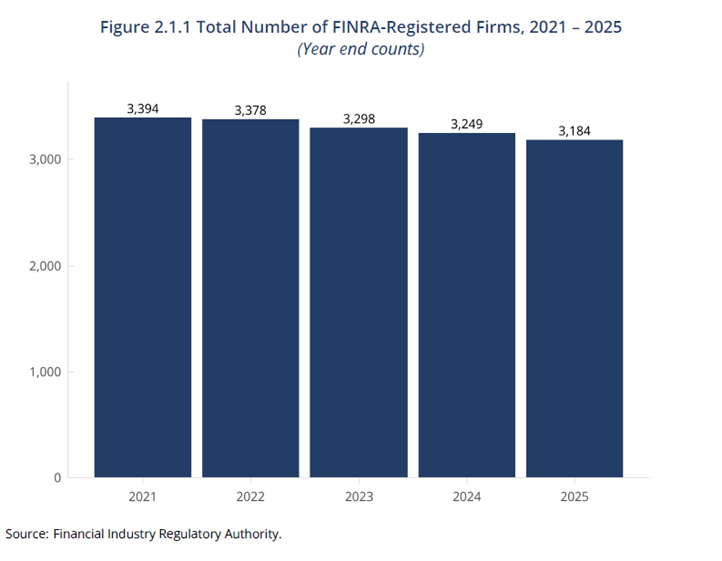
This trend reflects ongoing consolidation across the industry. Larger firms continue to expand through acquisitions, advisor recruiting, and platform growth, while smaller firms face increasing regulatory, operational, and technology-related costs.
Consolidation can create efficiencies, but it also introduces new supervisory challenges. As organizations grow, compliance teams must oversee larger populations of registered personnel, more complex business activities, and broader geographic footprints.
The result is straightforward. Supervisory systems and procedures must scale alongside the business.
The Rise of the Hybrid Professional
Another key development highlighted in the Industry Snapshot is the continued growth of dual registrants. More financial professionals now operate as both broker-dealer representatives and investment adviser representatives.
The hybrid model has become increasingly common as advisors seek greater flexibility in how they serve clients and deliver investment solutions.
While this evolution creates opportunities for firms and advisors, it also introduces additional regulatory considerations.
Dual registrants often operate under multiple regulatory frameworks, requiring firms to maintain clear supervisory procedures, manage conflicts of interest, oversee outside business activities, and ensure proper documentation across both brokerage and advisory functions.
As the industry continues moving toward hybrid service models, compliance programs must evolve accordingly.
Expanding Market Activity Creates New Oversight Demands
FINRA’s report also highlights significant growth in market activity, including record trading volumes and increased participation in extended-hours trading sessions.
Extended-hours trading now represents a meaningful portion of overall market activity, reflecting growing investor demand for flexibility and access outside traditional market hours.
At the same time, options trading activity continues to expand, with same-day expiration and short-dated options accounting for a growing share of overall volume.
For firms, these developments create new oversight responsibilities.
Surveillance programs, trade review processes, suitability monitoring, and risk management controls must adapt to trading activity occurring across a wider range of products and trading windows than ever before.
What was once considered specialized market activity is increasingly becoming part of everyday operations.
Growth Brings Greater Regulatory Expectations
A common misconception is that technology and modernization automatically reduce compliance burdens.
In reality, growth, automation, and digital transformation often increase regulatory expectations.
As firms adopt new technologies, expand service offerings, and support larger populations of registered representatives, regulators expect supervisory programs to evolve in parallel.
This includes:
- Enhanced supervisory procedures
- Stronger documentation practices
- Robust registration and licensing oversight
- Effective monitoring of outside business activities
- Comprehensive electronic communications supervision
- Ongoing testing and review of compliance controls
Regulators continue to emphasize that growth must be accompanied by effective supervision.
The firms best positioned for long-term success are those that view compliance as a strategic function rather than a reactive requirement.
What Broker-Dealers Should Be Thinking About
The trends identified in FINRA’s 2026 Industry Snapshot raise several important questions for firm leadership:
- Can your supervisory framework effectively scale as the business grows?
- Are your compliance resources keeping pace with increasing regulatory expectations?
- Do your procedures adequately address hybrid broker-dealer and advisory activities?
- Are your surveillance and monitoring programs aligned with today’s trading environment?
- Is your compliance infrastructure prepared for future examinations and regulatory reviews?
For many firms, answering these questions requires a fresh assessment of compliance programs, supervisory structures, and operational controls.
How FNEX Compliance Services Helps
As the securities industry continues to evolve, firms increasingly need compliance solutions that are scalable, practical, and aligned with regulatory expectations.
FNEX Compliance Services helps broker-dealers, investment banking firms, placement agents, and financial professionals navigate complex regulatory environments through outsourced compliance support, supervisory program development, registration management, compliance consulting, and ongoing regulatory guidance.
Whether supporting a growing firm, launching a new business line, or strengthening existing supervisory controls, FNEX provides the expertise and infrastructure necessary to help firms remain compliant while focusing on growth.
LEARN MORE ABOUT FNEX COMPLIANCE SERVICES
Looking Ahead
The most important takeaway from FINRA’s 2026 Industry Snapshot is not simply that the industry is growing. Complexity is growing alongside it.
Fewer firms are supporting more representatives, more business activities, and more sophisticated market participation than ever before.
In this environment, effective compliance is no longer just a regulatory requirement. It is a competitive advantage.
Firms that proactively strengthen their supervisory frameworks today will be better positioned to manage risk, adapt to industry change, and capitalize on future opportunities.
***Disclaimer: FNEX Capital does not provide interim or temporary sponsorship for the purpose of taking FINRA exams. Sponsorship is extended only to professionals and teams actively engaged in business under our broker-dealer platform.