

Private markets may still be labeled “alternative,” but for many RIAs, that term no longer reflects reality.
Across the fiduciary wealth channel, private equity, private credit, infrastructure, and real estate are shifting from satellite allocations to core portfolio building blocks. The drivers are clear: return enhancement, diversification, income generation, and access to a broader investable universe than public markets alone can provide.
The modern RIA is not asking whether to use private markets. The question is how to scale them efficiently and responsibly.
From Niche Allocation to Structural Exposure
Industry surveys in 2025 indicate that a growing percentage of RIAs allocate 10 percent or more of AUM to private markets, with the majority expecting to maintain or increase those allocations over the next five years.
This shift reflects structural changes in capital markets:
- Fewer public companies.
- More value creation occurring pre-IPO.
- Higher stock-bond correlations in inflationary regimes.
- Concentration risk within public equity indices.
As public market breadth narrows, private markets have expanded. For RIAs seeking differentiated returns and lower correlation, the opportunity set has widened meaningfully.
Asset Classes on the Rise
Private infrastructure has seen one of the most significant increases in advisor interest. The appeal is straightforward: essential assets, inflation linkage, durable cash flows, and operational value creation. Data centers, energy transition projects, logistics hubs, and transportation networks represent long-duration assets backed by real economic demand.
Private equity continues to attract capital for its ability to drive operational improvements and capture growth earlier in a company’s lifecycle. Historically, private equity has delivered strong long-term returns relative to public equities, particularly when active ownership enhances margins and strategic positioning.
Private credit has emerged as a flexible income solution. Asset-based finance and direct lending offer exposure to floating-rate structures and contractual cash flows that may help mitigate volatility in traditional fixed income portfolios.
Private real estate, particularly core-plus strategies, is gaining renewed attention amid more stable pricing, tax-efficient income characteristics, and attractive entry points in select sectors.
For RIAs, these are not tactical trades. They are long-term allocation decisions.
The Structural Case for Diversification
One of the most cited reasons for increasing private market exposure is diversification.
The historical assumption that bonds consistently offset equity volatility has weakened in recent years. As inflation pressures have shifted correlation dynamics, advisors are increasingly looking beyond traditional 60/40 frameworks.
Private infrastructure and real assets often exhibit lower correlations to public equities. Within private credit, asset-based strategies provide exposure to cash-flowing, non-corporate assets. Real estate and infrastructure may include explicit inflation pass-through mechanisms embedded in contracts or lease structures.
In a higher-for-longer environment, this matters.
Evergreen Structures Are Becoming the Default
Access structure is as important as asset class selection.
A significant majority of RIAs now utilize evergreen vehicles to gain private market exposure. The advantages are operational: streamlined onboarding, simplified subscriptions, scalable allocations across client accounts, periodic liquidity windows, and consistent reporting.
Drawdown funds still play a role, particularly for targeted sector or regional exposure. But evergreen vehicles provide flexibility that aligns more closely with the portfolio construction needs of wealth managers.
Technology platforms are also central to this evolution. Advisors increasingly rely on third-party systems to manage subscription documentation, reporting, and client-level allocation tracking at scale.
Private markets are no longer just an investment decision. They are an operational decision.
Education and Client Experience Remain Critical
Despite growing adoption, implementation challenges persist.
Client education ranks as the primary hurdle. Liquidity differences, fee structures, valuation timelines, and reporting mechanics require clear communication. Advisors must ensure expectations are aligned before capital is deployed.
At the same time, client outcomes are driving adoption. Tax efficiency, wealth growth, intergenerational transfer planning, and volatility management are consistent priorities among high-net-worth households.
Private markets can support those objectives, but only when integrated thoughtfully and transparently.
The Strategic Imperative for RIAs
Operational efficiency and relationship expansion are increasingly linked.
Firms that integrate private markets effectively often deepen client relationships by offering differentiated access. Broader product capability can strengthen retention and enhance competitive positioning, particularly as high-net-worth clients demonstrate greater willingness to change advisors for improved alignment and opportunity access.
Private markets are no longer simply a performance enhancer. They are a practice differentiator.
Scaling Private Markets With the Right Infrastructure: FNEX Alternatives Market
As RIAs increase allocations, platform selection becomes strategic.
The FNEX Alternatives Market is designed to help advisors access curated private equity, private credit, real estate, and infrastructure opportunities within a compliant, institutional framework.
Through the FNEX Alternatives Market, advisors gain access to vetted alternative investments, supported by due diligence processes, compliance oversight, and dedicated wholesaling support.
Private markets are no longer peripheral. They are central to modern portfolio construction.
The advisors who build scalable infrastructure, educate clients effectively, and partner with platforms that prioritize access and discipline will be positioned to lead in the next phase of wealth management.
Private markets are not just an alternative anymore. They are foundational.
Gain Direct Access to Alternative Investments with FNEX Alternatives Market
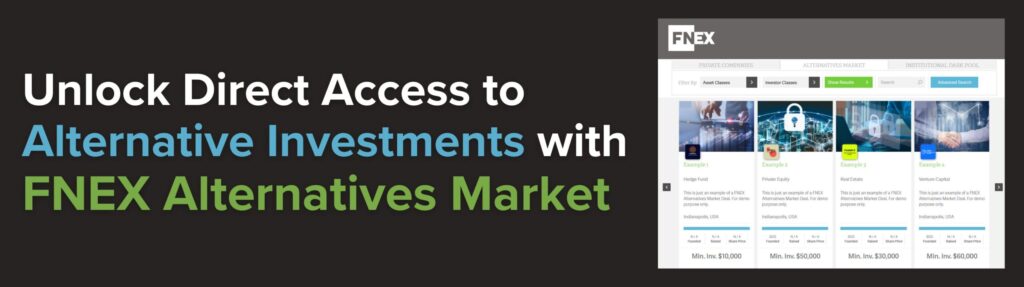
At FNEX, these allocation trends underscore the growing importance of curated access to alternative investments.
The FNEX Alternatives Market provides family offices, advisors, and accredited investors with access to private equity, private credit, real estate, and other alternative strategies designed to perform across inflationary and volatile environments.
Rather than broad exposure, FNEX emphasizes:
- Curated high-quality strategies
- Internal and third-party due diligence
- Access across multiple alternative asset classes
- A compliance-first, technology-enabled platform
As family offices continue to prepare for inflation, geopolitical risk, and shifting rate dynamics, alternatives are no longer tactical allocations. They are a structural component of modern portfolios.
This evolution positions the modern advisor not merely as an allocator but as a strategic partner guiding clients through the full spectrum of public and private markets. The future of wealth management belongs to those who can deliver institutional access with clarity and conviction.
Learn More About FNEX Alternatives Market
Unlock Alternative Investment Opportunities with FNEX
FNEX empowers advisors to deliver performance-driven, diversified portfolios through direct access to curated alternative investments.
Disclaimer: The FNEX Alternatives Marketplace is intended for use by financial professionals only. Access is restricted to registered investment advisors, broker-dealers, and other qualified institutional invest